- No products in the cart.








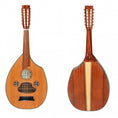
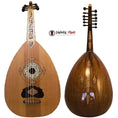


The Soul of the Orient: A Guide to the Different Kinds of Ouds

24
Apr
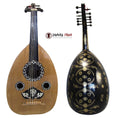
Often referred to as the "King of Instruments," the Oud is the fretless, pear-shaped ancestor of the European lute. Its deep, resonant voice has defined Middle Eastern, North African, and Central Asian music for millennia. However, not all ouds are created equal. Depending on the region, the construction, tuning, and even the "personality" of the instrument shift significantly.
1. The Arabic Oud
The Arabic oud is perhaps the most recognizable version of the instrument. It is generally larger and heavier than its cousins, producing a deep, bass-heavy, and warm tone.
-
Characteristics: It features a larger soundbox (bowl) and a slightly longer scale length.
-
Sound: Deep, romantic, and "round." It is designed to sustain notes and fill a room with a rich, woody resonance.
-
Tuning: Traditionally tuned lower than the Turkish variety to accommodate the "tarab" (ecstasy) style of music.
-
Where it’s played: Egypt, Iraq, Syria, Lebanon, and across the Arabian Peninsula.

2. The Turkish (and Greek) Oud
In Turkey and Greece (where it is called the Outi), the instrument takes on a different persona. It is built for speed, agility, and brightness.
-
Characteristics: Smaller and lighter than the Arabic oud, with a thinner soundboard (the face of the instrument). The strings are usually set at a lower tension.
-
Sound: Bright, sharp, and "crisp." It excels in fast, intricate melodic runs known as taksims.
-
Tuning: Usually tuned a whole step higher than the Arabic oud, which contributes to its piercing, energetic sound.
-
Where it’s played: Turkey, Greece, and parts of the Balkans.

3. The Iraqi Oud
While technically a subset of the Arabic oud, the Iraqi model (pioneered by legends like Munir Bashir) deserves its own category due to its unique construction.
-
The "Floating" Bridge: Unlike other ouds where the strings are tied to a bridge glued to the face, the Iraqi oud often uses a "floating" bridge similar to a violin or mandolin.
-
Sound: It has a more focused, "dry" sound with less sustain but incredible clarity. It was designed to highlight the technical virtuosity of the player.

4. The Persian Barbat
The Barbat is the historical predecessor to the modern oud. While it nearly went extinct, it has seen a massive revival in Iran over the last few decades.
-
Shape: It has a smaller body and a longer neck compared to the standard oud, giving it a silhouette that looks more like a teardrop than a pear.
-
Sound: It possesses a distinct, ancient character—less "boomy" than the Arabic oud but more haunting and mid-range focused.

Quick Comparison Table
| Feature | Arabic Oud | Turkish Oud | Iraqi Oud |
| Size | Large / Heavy | Small / Light | Medium |
| Tone | Warm & Deep | Bright & Sharp | Dry & Precise |
| Bridge | Fixed | Fixed | Often Floating |
| Vibe | Soulful / Meditative | Energetic / Virtuosic | Technical / Clear |
Whether you prefer the deep, tear-jerking resonance of an Arabic oud or the lightning-fast clarity of a Turkish model, this instrument remains a bridge between the ancient world and modern expression.
Find the perfect oud for you now!