- No products in the cart.










A Guide to the World of Frame Drums

07
Apr
The frame drum is one of the oldest and most widespread musical instruments in human history. Defined by a drumhead width that is greater than its depth, these simple yet profound instruments have provided the heartbeat for rituals, celebrations, and storytelling for millennia.
What is a Frame Drum?
At its most basic, a frame drum consists of a single drumhead, traditionally made of animal skin (though modern versions use synthetic materials), stretched over a shallow wooden hoop or "shell." Because the shallow shell provides very little resonance from the body itself, the sound is primarily determined by the tension of the skin and the way it is struck.
A Global Journey
While some variations are more common than others, frame drums appear in almost every corner of the world, each with its own unique construction and playing style:
-
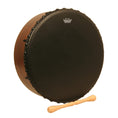
The Bodhrán (Ireland): A staple of Irish traditional music, played with a double-headed wooden stick called a "tipper." The player's free hand moves against the inside of the skin to change the pitch and timbre.

-
The Tar and Bendir (Middle East/North Africa): The Tar is a large, open-framed drum, while the Bendir features a "snare" made of gut strings stretched across the inside of the head, creating a buzzing resonance.

-
The Dof (Persia/Central Asia): Often associated with Sufi rituals, the Daf features metal rings or chains attached to the interior of the frame, which jingle and crash as the drum is played.

-
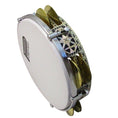
The Pandeiro (Brazil): A versatile drum that looks like a tambourine but is played with a sophisticated technique involving the thumb, fingertips, and heel of the hand to mimic a full drum kit.

The Kanjira (South India): A 7-inch powerhouse from the Carnatic tradition. Historically covered in monitor lizard skin, its head is kept loose and dampened with water, allowing the player to bend the pitch into deep, "liquid" bass notes that defy its tiny size.

Spiritual and Cultural Significance
Historically, frame drums were often the domain of women. In ancient Mesopotamia, Egypt, and Greece, priestesses used frame drums in religious ceremonies to invoke the divine. Today, they remain a powerful tool for meditation and "drum circles," valued for their ability to ground the player and create a sense of communal rhythm.
Modern Evolution
While deeply rooted in tradition, the frame drum has seen a massive resurgence in contemporary music. Modern virtuosos like Glen Velez and Layne Redmond helped pioneer "lap style" and "upright" techniques that blend traditional middle-eastern finger-tripping with Western percussion concepts.
Whether it is the haunting thump of a Bodhrán in a rainy pub or the intricate rhythmic cycles of a Daf in a concert hall, the frame drum continues to prove that you don't need a complex machine to create a world of sound—just a frame, a skin, and a heartbeat.
Does Size Matter?In the world of frame drums, size isn't just about volume; it’s about the physics of air, the tension of the skin, and the specific role the instrument plays in an ensemble. While a 10-inch drum and a 22-inch drum share the same basic anatomy, they occupy completely different sonic territories.
1. Small Frame Drums (8" – 12")
These drums are the "sopranos" of the family. Because the surface area is small, the skin is naturally under higher tension, resulting in a bright, crisp, and piercing tone.
-
Sonic Profile: High pitch with little sustain. They excel at "cracking" sounds and rapid-fire finger rolls.
-
Common Examples: The Kanjira (South India) or smaller Pandeiros.
-
The "Pop" Factor: These are often used as lead or solo instruments because their high frequency allows them to cut through a mix of louder, lower-pitched instruments.
2. Medium Frame Drums (14" – 18")
This is considered the "sweet spot" for many players. At this size, the drum begins to develop a distinct "Dum" (bass) and "Tek" (high) distinction.
-
Sonic Profile: A balanced mix of resonance and clarity. You get a satisfying bass note in the center, but the rim remains responsive for sharp accents.
-
Common Examples: The Bendir, Bodhrán, and standard Tar.
-
Versatility: These are the workhorses of the percussion world. They are large enough to provide a foundational rhythm but small enough to be held comfortably in the hands (upright style) or on the lap for extended periods.
3. Large Frame Drums (20" – 25"+)
Once you cross the 20-inch mark, the drum enters the "sub-woofer" category. The large surface area allows the skin to vibrate at much lower frequencies.
-
Sonic Profile: Deep, booming bass with long sustain. Because of the sheer amount of air being moved, these drums often produce overtones that can sound almost melodic or ethereal.
-
Common Examples: The Persian Daf or large Shamanic drums.
-
Physicality: These drums are heavy and often require specific holding techniques or even stands. The "snap" at the edge is less about a high-pitched click and more about a complex, textured "slap" that vibrates through the entire frame.
Now that you know pretty much all there is to know about frame drums, it's time to find the right one for you!
-